Showing posts with label fragrance. Show all posts

Friday, August 9, 2013

The Bottle Club


Yesterday I attended a meeting of perfume bottle collectors. 

Among vintage perfume collectors, these people are sometimes called “The Enemy.” They buy for the bottle, not the juice. And (the horror!) I’ve heard that some bottle sellers pour the perfume in them down the drain.

Incidentally, displaying fragrance in clear bottles is not advised. The perfume in them cooks in bright light, resulting in that nail polish remover top note vintage buyers know too well. So the beautiful bottles presented by Lalique yesterday — all clear glass — wouldn’t benefit any perfume that might be inside them. Not that you’re going to put your limited edition signed-and-numbered Lalique flacon inside a dark cabinet. Are you?

I wish I could display my collection on a dresser top or shelf. Many of the bottles are beautiful. But for me, display is limited to the opaque ones, because it’s the contents I care most about. You can’t wear a bottle. The bottle is something you own, but it doesn’t become part of you like perfume does.

There are some bottles that are swoonworthy, though. One is pictured above.

Elsa Schiaparelli was the grand doyenne of the perfume bottle as surrealist art. She collaborated with Salvador Dali on a number of perfume bottle projects. The most well-known one is the “Le Roi Soleil” bottle, crafted  by Baccarat, which was released in 1946 to celebrate the end of World War II. Dali drew the sun’s “face” as a series of birds in flight, across a rising sun, over an enamel-blue molded glass sea. (I haven’t been able to find any description of what the perfume inside smelled like — this alone is interesting, as such information is readily available on the ‘net nowadays — but most of Schaiparelli’s fragrances were of the take-no-prisoners type.) So, in this case, the bottle, er, eclipsed the perfume inside it. 

Even as a young girl I hoped to someday have a vanity, on which there would be a mirrored tray, full of fine perfumes in their beautiful bottles. The bottles atop my cabinet now — Agent Provacateur comes to mind, in its  pink ceramic egg crowned by a plain metal spray nozzle — aren’t the most appealing ones. Those are stashed safely in the dark interior.

For me, it was odd to walk into a room  like the one yesterday and not smell a bit of perfume. No one was wearing any. That included me. I didn’t want to offend. So, as I passed through the very upscale department store in which the meeting was held, I sprayed  samples of Kurkdijan and Ford  and Creed onto cards, not onto my skin as I usually would.

I guess these people love the bottles a beautiful objects, as art, so I ask: these art aficionados, these collectors, are they more in step with the concept of perfume as art than are those who (so I’ve heard) have been known to decant the perfume for wearing, and put the bottle up for sale to them?


The image of the Dali bottle for Le Roi Soleil comes from Richard Stamelman ’s book “Perfume”  c 2006, Rizzoli International Publications, Inc. No photo credit was given.

The Dali bottle in perfect condition, not that you’re interested in such things, is currently priced at around $25,000, if you can find one. I saw one on a popular auction site that was in very bad condition (chips, broken rays, faded, no box) for just under $4000.


Monday, July 22, 2013

Cult


I left Los Angeles nearly twenty years ago. I go back to visit family at least once a year, so in a way one foot is still there, and the place still beckons: the energy, the art, the variety, the feeling of being at the leading edge of well, everything. 

When I read about the opening of the Institute for Art and Olfaction last year, it made me want to go back. For a few days, anyway. It is fitting that this center arose in Los Angeles, as there is still an odd sort of purity associated with California that simply doesn’t exist in all-business New York.  (I don’t think I was the only blogger who was disappointed in MODA’s extremely well-sponsored and mainstream scent exhibition there.)  Anyway, if I was still in L.A. I’d be involved with the IAO. Sweep this ground floor. 

The IAO’s first conceptual scent project involved a collaboration between the filmmaker/software architect Mark Harris and conceptual perfumer Josh Meyer. Harris’s film “The Lost Children,” is described thusly on the IAO website:

“The Lost Children is a sci-fi thriller that tells the story of Evelyn Hamilton, a NYC socialite turned would-be messiah. Running from her troubled family, Evelyn joins The Lost Children cult, who believe they are aliens from another world, stranded on Earth and awaiting rescue by their mother ship. Evelyn’s family hires professional cult deprogrammer, Jared Allen Tyler, to extract her from the cult and to “un-brainwash” her. But soon everyone in the film questions what they know to be real as the cult’s beliefs all seem to come true.”

I haven’t seen the film. To my knowledge it hasn’t screened here in  At-Lanta. But I did order a sample of the scent that goes with it. It was featured in two live “immersive experiences” presented at The Film Society of Lincoln Center last January.

It would be silly to do a straight perfume review of “Cult,” but here’s an impression. Right away, I get the flat knockout punch of human body, not stale sweat, not cumin, human. (It fits. Cults are decidedly human.) That punch sticks around, too, through the mid tones of the scent, along with citrus and geranium. Later, it fades, and the result is a more pleasant drydown, with leaves and woods. Still, no mass-market fragrance distributor would touch this. It would give a niche perfumer pause. I’ll wear to some opening or other art event and see if it gets noticed.

But that’s not really the point here. 

Upcoming IAO projects involve a lot of multimedia and multimodal materials which serve to place the scent components within a broader structure, make them more familiar, perhaps more acceptable, to the rather, ahem, insular Art World. This should help disassociate art-based perfumery from the concept of “Perfume” as it exists today: celebrity-driven, fashion-associated, designed to seduce, certainly downmarket as compared to Art. 

While I would like someday to see conceptual scents stand alone as a painting would, this form of introduction works. I look forward to much more from the IAO. 


Click here to visit the Institute for Art and Olfaction's website. The link offering further information on the "Cult" project is here.

The photo is from the IAO's website.


Sunday, July 7, 2013

Sandrine Videault


It is not as through there are hundreds of fragrance artists, but there are some, and the passing of Sandrine Videault is a great loss to that small group.

Videault was a kind of anthropologist. She was born and lived on the impossibly beautiful tropical island of New Caledonia. In an interview with Perfume Shrine's Elena Vosnaki, she spoke of the indigenous tribe there, the Wallisians, who frequently rub perfumed pastes into their skin. She included some of their ingredients — Frangea, a white flower, sandalwood, Javanese vetiver — in her 2009 fragrance Manoumalia. She left some things the Wallisians used out, though;  most notably the hea seed, which she called “too rancid for the Western nose.”

So, we can see that Videault did assemble a perfume, not a reconstruction. A fragrance to be worn by Westerners on skin, to enhance, to make more beautiful, the wearer’s day. Is this art? I think it is.

So often, written descriptions of “olfactory art” seem kind of silly to me. It could be that all forms of  conceptual art have that in common. Perhaps they are better by far observed, or participated in, than read about. Videault composed olfactory art pieces as well as fragrances. Among them were an olfactory “happening” which included releases of metallic bubbles, presumably containing scent to be released when the bubbles burst, and “The Song of Senses,” an olfactory theatre with holograms. Both, I’d like to have seen.

Manoumalia, which I still have a drop of and am wearing as I write this, was a participant-observer fragrance, to use field-anthropology jargon. A student of the great perfumer Edmound Roudnitska, Videault knew how to construct a fragrance using naturals and synthetics, so although it references the Wallisians Tui-Tui fragrant paste, it is not the same thing.  Smelling the fragrance in its initial stages and in drydown, I perceive the unmistakable white flower essence, a little bit of rubber (common to tuberose) , a slight peppery quality in the middle, and the drydown just a hint of root and indole. On my skin, the fragrance is fleeting.

As is life.

I was happy that Sandrine Videault existed. I was waiting for more fascinating ideas and fragrances to come from her. But, like the Italian fragrance innovator Mona di Orio, she didn’t live long enough.

When asked by Vosnaki what one thing she’d learned from Edmound Rodniska, she replied it was that “we know nothing.”

That is a succinct description, the beginning, of inspiration.


Photo of Sandrine Videault courtesy of Google Images. Image may be subject to copyright.

Thanks to Scented Salamander for some of the material here.


Tuesday, June 12, 2012

Language Help: iTranslate


I’m terrible at French. I murder it. Just about every unfortunate French person who has ever heard my lame attempts to speak the language visibly winces.

I think this is because my “other” language is Spanish, although it’s disappearing now that I don’t hear it every day. Spanish was taught the old way in my high school, not by conversation but by drills; written word to speech, over and over and over (and over). The result is that, when confronted with a written French word, I can’t pronounce it. My mind returns to the Spanish vowel and consonant sounds and stays there.  A true source of shame when trying to talk about perfumes by name, so many of which are French!

Recently, Perfume Shrine featured an article about the website Frag Name of the Day featuring an interview with its author, Bela. I’ve been a fan of that site for quite a while now. But since I got an iPhone a few months ago, I’ve discovered a translating app that seems pretty amazing, especially for quick, one-sentence things like “Where is the ladies room” and “Will you take less for that?” as well as complicated perfume names.

There are quite a few of these translating apps, and I haven’t tried many, but the one I’m playing with now is  “iTranslate Voice,” by Sonico GmbH. You speak into it — a word, phrase, or sentence in your own language after selecting the appropriate icon, and that of the language in which you want to hear the phrase spoken (currently 31 languages). Voila, out it comes, perfectly pronounced, with both lines of text in written form too! (There’s also a keyboard, but I haven’t tried it.) 

This is one of those apps that makes me feel like I really am living in The Future. I’m sure it has limitations. They all do. I hear that quite a few people have given up on Siri — my iPhone is a hand-me-down 3G and I don’t have it— but give ‘em time. 

In the meantime, I can think of many uses for this!


Not affiliated, honest.

I ordered this from the iTunes store. Current price is $1.99. Apparently it’s available for Android also.

Illustration from Engadget (www.engadget.com) courtesy of Google Images.


Wednesday, May 30, 2012

YSL by DSH: A Perfume Look at Yves St. Laurent


I’m always happy to get a samples package from Dawn Spencer Hurwitz. I admire her sure hand. I know that the scents won’t be oily headshop concoctions, but real perfumes, as beautifully crafted as the most expensive ones, but with better ingredients. I had read about the YSL Retrospective Collection, so was thrilled to get a chance to try them.

Last week, I was doing a lot of research on Andy Warhol, for another project. When struggling with the concept of talent — is there such a thing, or is it just work? — it was learning about Warhol’s upbringing as a poor kid from a lower-class ethnic ghetto in Pittsburgh that finally pushed me to conclude that these abilities can be inborn.  

It occurred to me as I was looking into YSL that Yves St. Laurent’s position in the history of fashion was similar. He  was from a comparatively  elevated but certainly not extraordinary background, born in a small town in colonial Algeria. Both he and Warhol showed early talent. Both rose quickly. Both became giants, suffered health problems, and died relatively young.

St. Laurent popularized pants for women, even as formal wear. He was the first to use models of African descent. He attempted street fashion at a time when his clientele wouldn’t dream of wearing anything so downscale as, say, leather. He made oceans of money with his Ready-to-Wear line — also simply not done at the time — and introduced Opium perfume with scandalous images and an infamous launch event. When I look back through images of his collections I can see that most of us wore his ideas, in one way or another, even if they came in liquid form.

What Dawn Spencer Hurwitz has done is make fragrant tributes to St. Laurent’s most important, and most creative, chapters. She did this to coincide with the Denver Art Museum’s YSL Retrospective Exhibit, in which St. Laurent’s couture pieces are shown as what they were: art.


c. 1950: The Dior Years “Ligne Trapéze”

Yves St. Laurent became Art Director at Dior when he was only twenty-one. His first collection for the house was “Le Ligne Trapéze.”  Hurwitz writes that she was inspired by a gorgeous silver evening gown from that collection:  "Trapeze.”  
The fragrance is a cool aldehydic floral with a decidedly vintage feel. For me it occupies a space somewhere between Mitsouko (the peach skin) and Arpege (the aldehydes). The silver here is not of the “sucked silver spoon” variety, but more a concept of the color and patina of well-used sterling. It’s a slightly aloof bouquet that warms to the skin over time. Included in the notes are aldehydes, of course, and violet, but also jasmine, “suede” accord, vetiver and castoreum.

Image from the Fondation Pierre Bergé-Yves Saint Laurent.


c: 1958 − 1964: The Beat Look


One of my favorite old films is “a Bout de soufflé,” known in English as “Breathless.” Even now, it feels modern, still full of insouciance. Likewise this perfume, with its fruit and flowers, (not “fruity floral,” perish the thought!) underscored by leather. St. Laurent, like many of his countrymen, was fascinated with American motorcycle/beat culture at the time. This collection, for Dior, featured items like leather jackets and turtlenecks, and did not go over so well at Dior. St. Laurent left Dior after this, to fulfill his military service obligations. That didn’t go well either. He was hazed and taunted until he suffered a breakdown. After being released from service, he returned to Paris and started his own house.

This is my personal favorite from this collection. Notes include mirabelle plum, jasmine, orris, honeysuckle and leather.  The photo is Jean Seaberg, taken on the set of “a Bout de soufflé.”

c: 1968 − 1975: Le Smoking

“Le Smoking” was a YSL shorthand for the tuxedo, worn as evening dress by women. This was St. Laurent at his finest: daring, inspired by the women’s liberation movement of the time. Formal dress before this required horrors like “merry widow” corsets,  girdles and other forms of armor. The very idea of being able to sit comfortably at a formal dinner seemed revolutionary.

 “Le Smoking” is called a green chypre here, but what I sense is warmth; a beautifully green-floral beginning which settles into honey and tobacco leaves.  What makes this one so appealing are the bases, so well-blended that you get a feeling of incense, oakmoss and a bit of castoreum, but no aspirants and no scene-stealers. 

The photo, by Helmut Newton, from Google Images.


c: 1977 Opium Perfume  “Euphorisme D’Opium”


Opium perfume was iconic. Everybody wore it. The print ads featured Jerry Hall, Mick Jagger’s paramour and incredibly fabulous supermodel, reclining in a stupor on brocade cushions. For a couple of years every office and nightclub was filled women apparently aspiring to be that kind of  femme fatale. Opium was so ubiquitous, and so immediately recognizable that, like one of Warhol’s repeating disaster images, it ultimately lost its power.
  
This is a modern take on the idea of “Opium.” Clear, not murky. Conscious, not stuporous. The orange, carnation and clove bring up the Oriental association, but this is a bit more mannerly, with rose in the drydown. Don’t confuse it with the travesty currently being sold as “modern Opium” though! This one will elicit memories of the original formula, while being much more wearable.

The Opium ad came from French Vogue by way of Google Images.


c: 1983 Paris Perfume  “La Vie en Rose”

This is similar to “Paris,” the perfume St. Laurent said inspired the big-bow dress, but without the slap-you-stupid 80’s gigantism. Truth be told, I have always found “Paris” to be difficult to wear, but I also found huge shoulder pads to be daunting.  This is like “Paris,” minus the over-the-top quality. It has an aldehydic fizziness “Paris” didn’t have. It is still very much in the rose-violet camp, though. Notes include French rose, violet, violet leaf, cassis and civet.

The photo comes from the Denver Art Museum’s publicity materials for the retrospective.

c: 1994 − 2002 The Late Years  “Ma Plus Belle Historie d’Amour”

At his last haute couture show, Catherine Deneuve sang this song to him. By this time, St. Laurent was in failing health, barely able to walk down the runway after the show. He retired to Morocco soon afterward. This event highlighted his immense influence in haute couture, especially upon taste-making, powerful women. The fragrance is a ladies-who-lunch ozonic floral with one of the most beautiful jasmine-laced drydowns I’ve ever experienced in a perfume.

Yves St. Laurent dressed Catherine Deneuve for “Belle De Jour,” during which they became lifelong friends. Her appearance in that film is iconic; the classic, simple clothing, blonde mane, heavy Sixties eye makeup, stiff white lingerie.  To me, this fragrance is about her, in that film and later, as one of his great muses. Some of the notes here are linden, wisteria, sambac jasmine and ozone, all to great effect, romantic and wearable anywhere.

The photo is Catherine Deneuve and and Yves St. Laurent on the set of “Belle de Jour.”


The best thing about blogging is the learning. Before I began my research for this post, I knew a little  about Yves St. Laurent; he’d done Opium, the safari look and so on. I now know a lot more. I have never been a haute couture customer, but I’ve worn tuxedo jackets, safari-like shirts, pantsuits, brocaded jackets and Opium. Except for the last, I had no idea that it was Yves St. Laurent who came up with all of them. 

“You live your life in it,” says Stanley Tucci as Nigel, explaining why fashion can be art to the clueless Andy in “The Devil Wears Prada.” As fashion can be art, so can fragrance.


For more information, prices and a complete listing of the “notes” of each fragrance, visit www.DSHPerfumes.com

Photo crédits: Le Ligne Trapeze dress: http://collections.vam.ac.uk/item/016821. Photo of Jean Seburg from pagesdigital.com. Photo of Catherine Deneuve and Yves St. Laurent from http://blogue.us/wp-content/uploads/2010/11/catherine-deneuve-belle-de-jour.jpg. Other photos are credited in the text.


Full disclosure: DSH Perfumes provided me with PR materials and 1 ml samples.


Tuesday, May 22, 2012

Suggestive Perfume Bottles, vol. 2


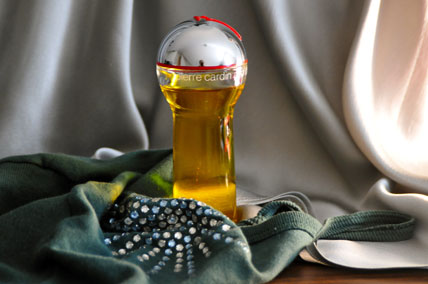
I recently bought a bottle of Caron’s “Montaigne” on fleabay, and the seller threw in this bottle of Pierre Cardin’s eponymous scent, after-shave version. 

The bottle needs little introduction. It’s the big-mack-daddy of ridiculous perfume bottles, nearly always cited as such when the subject comes up on blogs and perfume fora. It is, though, so very much of its time. That would be a time many who lived through would like to forget. 

“Pierre Cardin pour Monsieur” came out in 1972. My personal cascade of memories from that storied year includes:

Burt Reynold’s hairy visage as the first “Playgirl” centerfold; actually, Burt Reynolds. “The Joy of Sex,” featuring line drawings of a portly couple doing, y’know, it. “The Sensuous Woman” by “J.” The Loud family blaring it all on PBS in “An American Family.” The first — very first — disco records on the radio. Halter tops (that’s one of mine, from 1972, in the photo). The end of the earnest hippie; the resurgence of detached Hip. “Oui” magazine. Shag haircuts and, damn it, having to start styling your hair again. Cocaine amongst the cognoscenti. The end of Levi 501’s and the beginning of “designer” jeans. Um, waterbeds. Suburban couples lining up to see porn movies at the local Pussycat theater. Really Wide Ties. Muttonchop sideburns and fat mustaches. Shiny shirts with big collars. Deep tans. Hair spray for men.

…and that’s just a few of the references that come to (my) mind when I look at this bottle.

I’m not sure how old this one is. The cologne is still in production, but, in the usual sad story, has been sold and sold again and can now be had in discount drugstores for practically nothing. I think my bottle has some age, because the scent inside has things I recognize from other vintage fragrances I have — leather, geranium, tonka, oakmoss. And, although it starts out gag-me sweet, that quickly dissipates and becomes something that is…not too bad. It actually smells a lot like Habit Rouge, which was marketed for years as the scent one wears while riding to the hounds. 

This one is decidedly Seventies, for the peacock-man of the time. Brian Ferry might have worn Habit Rouge but I bet he never wore this! I’d say it sits somewhere between Habit Rouge and those really downmarket drugstore musks-for-men. 

And then there’s that, y’know, bottle.

Did you live through the Seventies? Do you remember them? So share already! (Posting as “Anonymous” is fine.)


According to Basenotes, the “notes” for Pierre Cardin pour Monsieur are lemon, bergamot, orange, lavender, basil, carnation, geranium, leather, sandalwood, patchouli, orris, vanilla, moss, tonka, benzoin and “amber.” 

photo by Patricia Borow, aka Olfacta. 


Monday, May 14, 2012

Leather Love: Peau d'Espagne


I have a problem with many leather fragrances. It’s really not with leather itself, but overuse of the aromachemical isobutylquinoline, usually shortened to IBQ.  A few years ago I got a bit of it in an introductory perfume notes kit, and soon realized that, even in a 4% dilution, it was the schoolyard bully; no matter how little I used in a mix, it knocked everything else out of the way. After that, I could instantly recognize its brass-knuckles presence in just about every “leather” fragrance out there. (When I made my series “Scents of Place” for my January art exhibit, one was called “New Leather Jacket.”  It contained — you guessed it — IBQ and a bit of dirty musk.) Anyway, the smell we call “leather” is nearly always IBQ.

My Peau d’Espagne doesn’t smell as though there is one bit of IBQ in it. So quite a few of the Basenotes reviews I’ve read say something like “where’s the leather in this?” or “the leather fragrance without any leather.” Our noses get so numbed by these synthetics, in perfumery and in functional household products like detergent, that subtlety is sometimes lost. But to me, anyway, this is a gorgeous leather; softened by years and care, nothing like the simulacrum IBQ.

“Peau d’Espagne” means “skin of Spain.” Spanish skins, sometimes known as Cordovan leather, came into common use in the 9th century, as the Andalusian city Cordoba was becoming a great center of learning and art. The skins, usually goat, were tanned and then embossed and gilded for use as wall hangings, like the tapestries hung on castle walls in northern Europe. These leather hangings kept out drafts and had the additional benefit of being resistant to insects. The art of making them was North African, or Moorish — the Moors ruled Andalucia for eight centuries, and Cordoba was their capital.

The version I have is from Santa Maria Novella, the Italian house that remains the oldest perfumery still in operation; this fragrance dates to 1901. (There have been other fragrances with the same name.) I got it in a split, and it’s marked “vintage,” and although I don’t know exactly what vintage it is, it smells fresh and unspoiled.

The opening notes of Peau d’Espagne are not for the faint-hearted. Anise jumps out with its licorice smell, like a first sip of Pernod or the dry version of “Chinchon,” an anise liqueur which I’ve never seen anywhere outside Spain. There is a slight medicinal bitterness, a volatility that gives a bitter taste on my lips as I sniff it, and then a gentle morph into essences of herbs and florals. I’ve read that the Spanish tanners used rose and orange woods, with lavender, and spices like cloves and cinnamon, and civet, and musk. So this leather is more about the substances once used to produce it than what we now call “leather.” That must have been the smell of tanning chemicals the leather absorbed, to be later synthesized as IBQ.

The fragrance continues in this way for quite awhile, with the herbs and florals flowing across the skin, back and forth and back again, while the bottom notes arrange themselves and gradually rise. (There is a supposed quote from Havelock Ellis that peau d’espagne is “often the favorite scent of sensuous persons.” I can see this.) These base notes are skinlike, with subtle musk  and dust — possibly a bit of myrrh -- and a slight — very slight — civet, just an echo, really, appearing and disappearing in rhythm with all the other notes. If I had to characterize this fragrance succinctly, I’d call it elusive. On the back of my hand, it has dried down after about an hour to a subtle and delicious skin scent — idealized skin.

The skin I wish I had.


The photo was taken at the Seville Fair and is titled “Young Aristocrat, Seville, Spain, April 2004.” Sounds a little silly, but it’s accurate. Members of the old families of Seville, in traditional dress, parade grandly on their Andalusian horses through the Feria de Sevilla grounds. The children are taught to ride almost as soon as they can walk. 

“Peau d’Espagne,” from Santa Maria Novella, is available in Europe and here and there in the U.S. at a reasonable price — around $125 for 100 mls.


Monday, May 7, 2012

Eeeewwwoud -- Trading in the Golden Triangle


Do you remember the first time you smelled oud? I certainly do!

It was unfortunate, in a way, that my initial exposure to the oud note in fragrace was the infamous, stonking Montale Black Oud. It put me off synthetic ouds forever, or so I thought — once I found out that the oud was, in fact, synthetic. Off I went as usual, to search for the real thing.

I doubt that I’ve ever found it. I thought I had, with some expensive niche perfumes I’ve sampled this year. 

It seems that the skyrocketing demand for natural, Southeast Asian oud has turned agarwood into gold and put the trees that produce it on endangered lists. The few remaining agarwood trees of Laos and the highlands of Vietnam, sources of the highest grades, are extremely hard to reach (a week’s hike in the jungle or so). That’s only the beginning; getting the wood out of the jungle is even more dangerous. Local villagers, for example, might be recruited to inform members of Vietnamese trading networks about sightings of wood haulers. By one account I read, local police sometimes “confiscate” the harvested wood for the traders, who then sell it up and down the line in an organization known as the Agarwood Mafia. They don’t treat independent wood hunters, who they call smugglers, kindly.
  
If you are a foreign concern and want to legally participate in the agarwood trade, a very large and very local bank account must be established, and many deposits must be made. If that works out and your deal goes through, your agarwood oil or distillate is likely to have been stepped on — about ten times is the average for a western purveyor. But, in recent years you’d be lucky to get anything at all, because China appears to have cornered the agarwood market.

In parts of China, infected agarwood (sometimes called “sinking wood”) is a good luck charm.  Although the wood itself is difficult to carve, the highest grades are used anyway, because those who hold this superstition want the very best, heaviest, fastest-sinking wood. According to one wood harvester, the Chinese factories do a pretty good business in leftover, low-quality agarwood chips, soaked in synthetic oud and sold as high-grade oud wood. (The beads and charms themselves are frequently carved from other heavy woods and then soaked in the synthetic oud while the buyer stockpiles any real agarwood he finds.)

So, when you buy that big bottle of Steam Oud from an online discounter for around $150 — well, you get my drift. Common sense tells me that a higher — much higher — price point for the latest niche oud fragrance is no guarantee either. I have a small sample — a drop maybe — of oud oil and even the botanical company from which I got it freely admits that it may not be of the highest possible quality. (Hey, at least they admit it!) So I’m wondering what it is, exactly, that I have been smelling all this time. The answer of course is synthetics.  They, like real oud, vary in quality, but many are better than they once were.

One heartening note: Agarwood plantations are in the works now. I’ve even heard of U.S. efforts  in Florida. But properly inoculating the trees with the oud-producing Phaeoacremonium parasitica fungus is difficult, too. A tree planted today will take thirty years to produce the prized infected wood.

Maybe synthetic oud isn’t so bad. 

I have given away quite a few samples of oud-laced fragrances. I kept a large vial of YSL’s M7 because I’ve always liked it, even before I knew what oud was. (Can’t find it today, of course.) And I liked Mona di Orio’s fairly recent oud. And a few other niche offerings. Some imply that their oud is real. After my research for this post, I don’t see how. But, after discovering what goes on in the wild agarwood harvesting business, I’m not so sure I’d want it anyway.

That having been said, I really do love the recent “Trayee” (Neela Vermiere Creations), which was developed by perfumer Bertrand Duchafour. A wonderful reader and I were doing some swapping, and she sent me some — the generosity of perfume lovers always amazes me. It’s the only oud-featuring fragrance I’ve ever liked this much. Green and woody and a little floral, too, it’s hugely strong and lasts forever. The oud in it? Probably  synthetic. And if that’s a problem…well, is it really?


photo courtesy of Google Images.


Monday, April 23, 2012

Musk and Masculinity


I missed musk. 

It was a sort of downmarket, Seventies thing, associated (by me anyway) with polyester, discos, gold chains and sex with strangers. The idea, from the era’s print ads I saw, was that cheap drugstore musk made all women swoon and surrender. Even then, that idea was cringe-inducing. So, when I saw a small bottle of Houbigant’s “Musk Monsieur” at an estate sale recently, I uncapped and sniffed it as a sort of  private joke, expecting the worst — cheap crap, the fragrance equivalent of a rotating mirrored ball.

It floored me. Never mind the musk. This scent, to me, was the quality “masculinity” in a bottle.

When one has an intense olfactory experience like this, it usually means that the scent is hitting some neuronal cluster or group of them in the brain, eliciting powerful cognitive associations. I knew mine weren’t about Daddy. My father called all men’s colognes “stink-um” and never wore them. (My husband has begun to wear cologne only recently, and even then only a small bit of it — my gifts to him include a couple of Etat Libre d’Orange favorites and Tom Ford’s Tobacco Vanilla. Not what you’d call old school.) But I bought the little bottle for a couple of bucks. I brought it home and said to him, “You have to try this. It’s so masculine.” I liked it so much that when a larger bottle came up for sale at auction, I bought it too. 

Last week, on “Mad Men,” there was a scene in which Don fixes a sink. His much younger wife looks on in adoration. Women like me grew up with fathers and uncles who knew how to fix things. I think it was because they’d been in the military and in wars, both arenas where it was do or die. Musk notwithstanding, to me this is that scent: a man who can make things work, and make me feel safe. 

Silly, I know. So out of time. But one must be honest about the emotional content of one’s memories — especially scent memories. They demand it.

So what is this stuff?

There are two versions. Both my bottles are the original Houbigant ones, as far as I can tell (the word “Houbigant” on the bottles was my first clue) although I think the smaller one might be a little older. The cologne was released in 1973. Dana bought it some time in the 80’s — accounts differ — and although the newer bottles are similar, the word “Houbigant” is missing. I haven’t smelled the Dana version but, if I know anything at all about these kinds of licensing deals,  my guess is that it’s probably very different. 

The “notes” are so well-blended that they’re not easily listed, but there is a lot of barbershop here, which usually means bay rum.  The fragrance differs a bit between the two bottles — one opens a little “brighter,” while the other is smoky right away; the first remains a little greener and sweeter while the second dries down to the pure fur/musk lushness. (Subtle differences between batches were much more common in the era where some naturals were still used.) Both have lots of tobacco, a bit of green, blended aromatics, and musk. Both sink into the skin and last for hours.

I still haven’t figured out why this scent says “man” to me. And I wonder what modern scents would represent masculinity. What qualities might be associated with that broader term. Is modern masculinity still about mastery of the physical environment, confidence and strength?  Is it about humor, gamesmanship, insight?  Or is it ridiculous to even categorize like this any more?

What is “masculinity” to you, and what modern scents, if any, capture that quality for you? 

Monday, April 16, 2012

Suggestive Perfume Bottles, vol. 1


A friend gave me this bottle a couple of years ago. The bulb is embossed with the words "DeVilleBliss." I've seen them in antique stores once or twice. Anybody know the age and/or provenance of it?

(2017 edit: it was a nasal irrigator! I guess you were supposed to fill the bottle with water or something, then blast it up into your sinuses by squeezing the bulb. Ewwww!)

Monday, March 5, 2012

Dream State Sniffing


Back in December, the sole of my stupid shoe met a slick spot, and I fell on my, well, left knee. I didn’t think it was that big a deal. I iced it, rested it, compressed it and even had a few physical therapy sessions, but it got worse. The upshot of all this is that I had to have knee surgery last Friday. Arthroscopic, but they put me under, anyway. The only good thing about surgery is that you get good guilt-free drugs afterwards; Percocet, Narco, you know. Those.
So there I was, in the Hall of the Mountain King, I mean, um in bed for days, sternly forbidden to get up unless absolutely necessary. What to do, what to do. Couldn’t read — the pills made it too hard to concentrate. TV’s upstairs and stairs are definitely out. 
So, I had myself quite a delirious little sniffing party.
We all have those vials and samples and decants, and they’re all over the place, and we really mean to get around to truly experiencing them, right? And never do. But here I was and here they all were and here was an envelope with hundreds of paper strips in it. And I thought, what if I sniff all these again, but in a sort of hallucinatory way? (As if I had a choice, hah!) No “notes?” No analyzing, just breathing the smell, living inside it for a few minutes, being here now or there then or whatever; of course!
Here are some of my notations.
Diptyque Eau Duelle: a knife on a pillow. Sharp and plush.
Cumming (hey remember that one?) dark and basement-dank. That would be the suburban basement where the Goth Kid, 30, still lives.
Cartier L’Huere Defendue: Channeling Pierre Guillaume: spice leather dark rich, great!
Cartier L’Huere Fougeuese: Davana! Yeah! Like “Safari” without the ice-pick sweetness, savannah, open prairie, grasslands.
SL Chergui: tobacco mint basil booze.
Shalimar PDT, Vintage: grrrrr….more resin less sweetness. 
Divine Folie (perfume): dry, cold, stern.
A Tase of Heaven, by Kilian: mint ice cream
Jicky, Guerlain EDT (modern) Fecal, fast
Chanel No. 19, vintage: faint at first, sharp bladed jonquils later
Amrytis, Mona di Orio: What exactly is this supposed to be? (Later): What exactly is this supposed to be?
Derby, Guerlain, modern: A really great bathroom spray
Coze, PG: patchy hay, nutty musk, Humboldt County
…and so on.
You know what? It’s really hard not to think in terms of “notes.” 
I guess we have to be forced to slow down now. This is a pretty good way, if you don’t count the surgery part.
More than once the DH found me, passed outasleep with paper strips sticking out of my nose. 
Hey, the knee’s a lot better now! Down to only one crutch, which I hope to throw away tomorrow after I see the Doctor P.A.!
And back to Advil, damn it.


All samples obtained by purchase or swap.

Photo, of my actual nightstand, by Olfacta.

Monday, January 2, 2012

A Break


As many (well, some) of you know, I’m a visual artist as well as a perfume blogger, and I have a show coming up January 28. I don’t want to insult you with deadline-meeting whatever, so I’m taking a break — I'll be back Tuesday, February 7. 

This year I plan to stress the “Rama” part of “OlfactaRama” a little more. In other words, expand the subject matter a bit, to include other subjects plus perfume. It’s a big world out there. Lots of stuff clamoring for attention.

So, I’ll see you in a few weeks!

Monday, December 5, 2011

Delving Into Chanel No. 5


I’ve been reading the new book “Coco Chanel An Intimate Life” by Lisa Chaney — review next week — so have become more interested in Chanel No. 5 than before. (This is probably an admission of heresy for a perfume blogger, I know.) Having the requisite ¼ ounce bottle of the parfum and a little bit left in a 1 oz. coffret bottle of the Eau de Toilette I bought years ago, I didn’t think I needed to explore the subject further. I thought: really, what’s there to say about No. 5 that hasn’t already been said, and said better?

Then I went to an estate sale last Friday. I spotted a nearly full 2-oz. bottle of Chanel No. 5 Eau de Cologne, and bought it for ten bucks. It looked old, but one can never be sure with No. 5 — I’ve avoided buying it on Our Favorite Auction Site, as it’s the most likely of all perfumes to be fake. It smelled very different from either of my early 90’s versions, and I wondered if I'd been burned. I’ve been doing research on it all morning, have found that it is real, and could actually be significantly old, since the Eau de Cologne formula was discontinued some time in the 90’s. (The bottles are pictured to the left.)

The label has a very different typeface than the modern ones, finer sans serif lettering in a different arrangement than is used now on Chanel bottles — the “Eau De Cologne” is above the No5, and the name “Chanel” is at the bottom. The circled double C logo on the top is etched into the material — probably plastic, maybe bakelite, it’s hard to tell — whereas, on the new bottles, it looks and feels painted on. The back of the bottle reads “Chanel, Inc. New York Distributor,” painted on. The bottom has the word "Chanel" embossed, and, below it, the number 8.

How many angels can dance on the head of a pin?

Generally, I don’t give a rat’s about bottles. This one intrigued me, though, because its contents don’t smell like any other formulation of No. 5 I’ve tried. I get old aldehydes at first, of course, but then there is a slightly soapy, dark, nearly masculine quality. Aspects of it remind me of an old 60’s bottle of “Woodhue” cologne I have, which, I’ve been told, is chock-full of nitro musks, and I think maybe this is, too. I don’t really know, though, because I’ve only been able to date it as being sometime between 1951 and the 90’s. I read that the “New York Distributor” phrase on the back was used between the late 40’s through the 50’s. I found a print ad from 1969 showing the same label as my bottle, but without anything on the back — although that doesn’t mean much; it might have been airbrushed out for aesthetic reasons. 

A couple of months ago, a neighbor saw me outside, and rushed over with an empty Chanel ¼ oz. perfume bottle that had been his mother-in-law’s. He was sure it was a rare and valuable treasure. It was probably from the 80’s, as best as I could guess, and I didn’t have the heart to tell him that there were approximately a million of them just like it out there. This is what bottle buyers go through, I suppose. I referred him to a Chanel perfume bottle dating site

Anyway, what I find to be interesting about all this is the different formulas for No. 5. My 90’s EDT smells of jasmine, a synthetic one, as I’ve read that only the parfum uses real jasmine or rose any more (and who knows if they still do.) The perfume is very different from that, sweeter, with a mellowness that says “naturals” to my nose — and there probably were at least some in the early 90’s. The old EDC screams aldehydes, almost like My Sin or Lanvin’s Rumeur. It could be that the midnotes are just degraded, though; eventually, it sweetens a little and becomes recognizable.

I’ve read that there have been around 60 books written about Coco Chanel, at least two films, and more books coming out. She was this; she was that, no she wasn’t, yes she was! She seems to me to have been a fierce sort of chameleon, someone who could, and did, adapt. All these versions of this perfume, her most enduring product — the formulae, the bottles, labels, fakes, controversy, quibbling over detail — could turn out to be her most recognizable legacy.


Any Chanel bottle experts out there? Fill me in!

Full review of “Coco Chanel An Intimate Life” will appear here next week. 


Monday, November 28, 2011

Like Nothing Else: Loulou


I wondered if there was anything in my collection that was truly unique. That really didn’t smell like anything else. 

Awhile back, I’d made a purchase of 40 or so minis, always a risk because minis are usually the first to go “off.” I lucked out, though. Only a few had. The rest — vintage Caleche, Ombre Rose, even the original Chloe — were still good. Among them was a strange, squat hexagonal blue bottle with a maroon spire cap: Loulou. I vaguely recognized it. I put it away for further reference.

Last week I finally got around to smelling it.

This does not smell like anything else I have. I think it’s one of those Rashomon perfumes — eight blind men, one elephant, eight widely varying guesses. Reading comments here and there on the forums, I seen everything from “too sweet” to “tuberose,” and I wonder, once again, if they’re just smelling something I can’t.

To me, “Loulou” is anything but sweet. It’s heavy and dark, full of wood and spice; cassis, a little jasmine, the herbaceous flower tagetes, plum (skin, not flesh.)  Aldehydes. Some heliotrope, certainly not enough to make it sweet! I’ve seen it compared to L’Huere Bleue, but to my nose they’re no more than minimally similar. (Having just applied a little LHB vintage extract to my other hand, I can see the resemblance, but this A to B comparison leads me to a new “note” in Loulou — coffee. That is to say, molecules assembled in such a way as to remind me of coffee. And I haven’t seen “coffee” listed anywhere else.) 

“Notes.” More and more, we hear they’re marketing-speak, nothing more; useful to prospective buyers, as one wants to have some idea about what one is getting, more or less. From reading descriptions of “Loulou,” it would appear that one is getting The Eighties in a bottle — “a frag with shoulder pads,” somebody said.

Well, I don’t think so. It’s true that this is powerful stuff. And I guess it does have something in common with Opium, the darkness and spices. But there is much more of the former than the latter here. When I think of the Eighties I think Little-Shop-of-Horrors tuberose: choose your Poison. This isn’t that. This is a truly dark, mysterious scent, a femme fatale perfume if there ever was one, reaching much further back into time than The Eighties. (The name “Loulou” refers to Louise Brooks, with the Twenties pageboy bob.)

My little mini is vintage, made of the same opaline glass as the big bottle (the spire top, though, is plastic). Judging from the label on the bottom, it’s pretty old. And I swear I keep smelling castoreum in there somewhere.

LouLou isn’t discontinued. It’s available on the discounters for a song, although it’s in a big ordinary bottle and, dollars to doughnuts, the bottle is plastic and the scent inside is reformulated beyond recognition, at least compared to the mini I have. Maybe that’s what all the commenters who call it “sweet” have been smelling. These minis like mine, though, show up all over, and they’re not expensive; around ten bucks usually for the EDP.

I will wear this out some night, the kind of night where I might otherwise wear L’Ombre Fauve — one that calls for some dark, sultry scent. One I know the DH will like, because he’s already told me he does. I’d like to see what others say about it. I think it’s in the same conceptual ballpark as the real (read: wildly expensive) ouds.

The garish colors of the bottle, the maroon and cyan, aren’t about the Eighties, either. They were used by Matisse often enough to become associated with him.  That’s one his paintings, “The Casbah Door,” from 1912. 


“Loulou” was released in 1987. The perfumer was Jean Guichard, who also did “Obsession” for Calvin Klein.

The painting image came from here.


Monday, November 14, 2011

Random Thoughts at 3 a.m.


The EU is in the process of, or already has, banned (are you ready?) balloons. It seems that a child could choke on one while blowing it up. 

How did I ever survive my childhood?

My first job? Filling balloons with helium at a theme park. Most common request from customers? “Don’t tie a knot in it!” First surreal experience? Watching 12-year-olds lurch around talking like Donald Duck.

Caron’s En Avion — smells like a refo; dentist’s-office clove and something ghastly sweet. The older stuff must have been great, though. 

I smell a ghost.

SmartPhones don’t make you smarter. They do make their users stop in the middle of the aisle to read whatever is so important, thereby causing shopping cart pile-ups. I personally saw three of them yesterday.

(Why do you think they call them “users?”)

“Hung” (HBO) was a surprise last season. Very good writing and characterization. This season? I think they replaced the writers with a bunch of high school boys. Even “Ray” looks embarrassed to be in this sleazy mess.

Last night: EL’s Tuberose Gardenia. Firmly in Fracas territory. Is this being discontinued?

I sold a couple of old drawings last week. Made just enough to pay for the print rack I had to buy to display them. 

Parfumerie Generale’s “L’Ombre Fauve” — could well be the quintessential fall fragrance. 

(Ever notice how the declarative statement has disappeared from the lexicon? Now it’s “possibly” and “quite possibly” and “just may be” and “could well be” — see above — instead. What does this say about American culture?) 

I think it’s the troll living in Mom’s basement at age 35 that we’re all scared of. You know the one. Has nothing better to do than research obscurities, then write complaint letters whenever some hapless writer gets some factoid Wrong.

(Well, him — funny how it’s always a him — and the lawyers.)

New HBO show: “Enlightened.” Starring the woefully underappreciated Laura Dern (who also conceived and developed it.) Goofy, scary character you can’t help but root for, trying to retain her humanity in the horrifying modern workplace.

European readers — still think the EU is a good idea? (This isn’t snark. I would really like to hear your thoughts.)


Balloon photo used under much too expensive license from Dreamstime.com