Showing posts with label perfume ingredients. Show all posts

Monday, May 23, 2011

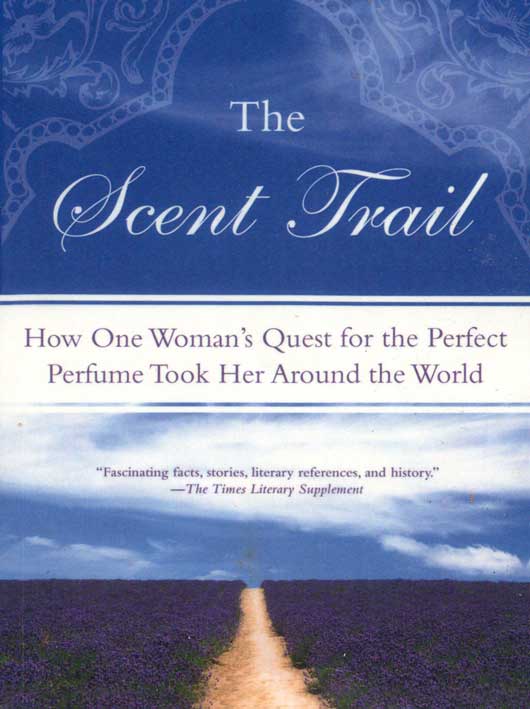
Book Review -- “The Scent Trail (How One Woman’s Quest for the Perfect Perfume Took Her Around the World)” by Celia Lyttelton


I was surprised when I saw, on some book-buying site, a book about perfumery that I hadn’t ever heard of. I think that’s because this is a travel book, conceived, written and probably shelved in the “Travel” section, and it’s a great travel book.
The lucky Ms. Lyttelton, who is the daughter of archaeologist Margaret Lyttleton, grew up on the move, and now has no qualms about nosing around souks and asking impertinent questions. This is the perfect trip. Lyttelton spends two years investigating the ingredients she’s chosen for a bespoke perfume. At the beginning of the book, she meets with a custom perfumer, and they work out a fragrance for her. The ingredients she chooses are neroli, petitgrain, sambac jasmine, mimosa, damask rose, iris, nutmeg, vetiver, frankincense, myrrh and ambergris. 
“So I set out,” she writes, “for the places where these ingredients grow, to meet the people who harvest them and to discover at least some of the secrets of perfume making from the perfumers who ‘magic’ the raw ingredients into scent.”
Off she goes, husband, (sometimes) toddler and translators in tow, to mythical places like Grasse, Paris (where she talks with Frederic Malle), Morocco (where she talks with Serge Lutens), Florence, where the irises grow, Turkey for rose, India and Sri Lanka for jasmine and vetiver, and finally Yemen for frankincense and myrrh, and to search the island of Socatra’s beaches and souks for real ambergris.
This book came out in 2007, when Yemen wasn’t quite as dicey as it is now, although it was an uncommon destination for westerners. She speaks of having once gotten lost in the desert with her mother in that country and being rescued by Bedouins. Clearly, she’s comfortable wherever this trail leads.
Lyttelton makes some assumptions that aren’t always true (“once you’ve smelled something for the first time, the next time you encounter that smell you can immediately identify it”...uh, I can’t) and she also speaks of clearing the nasal palate with coffee beans, which is currently being disproved, but I’m splitting hairs here. (Can’t help but wonder what Sephora plans to do with all those beans, though.) She’s done her homework -- lots of it. 
“The Scent Trail” is a very entertaining book, full of primary information about how the natural ingredients for perfumes are obtained. She touches on the subject of synthetics, but not much -- things were a bit different when this book was being written (“Buddah,” she says, “is in, and boudoir is out” -- this before the tasteful Marc Jacobs/Tom Ford print ads, I assume.) What has happened since then, with the reformulations, the no-scent movement and the over-regulation of ingredients made reading about all this history and mystery a sad experience; I can’t help but think about what might have been, and what the perfume business has become -- all business. 
I’m increasingly grateful to the suppliers of these ingredients, because I’m not planning a trip to Yemen anytime soon (Paris maybe; one can always hope!), but know that if I really want a tiny bit of ambergris tincture or jasmine absolute, I can find them, and smell them and think about what she called “magic-ing” these storied raw ingredients into scents.
 Lyttelton credits the perfume she had made with tremendous power, to draw others closer, and, most importantly, to transport her to all the places she went to in her effort to understand this art. “My scent,” she says, “encapsulates distant lands, and its aromatic composition is filled with stories.” 
“The Scent Trail” is available in paperback. The ISBN is 978-0-451-22624-2.
The book’s cover design is by Oceana Gottlieb.

Monday, May 2, 2011

Honeysuckle Memory


When I was a child, my parents would release me to the outdoors after dinner. Summer dusks here are long, and all the other kids would be sprung in the same way, to “go outside and play.”  Our playground was enormous, patches of woods at either end of the street, and big, sloping back yards. Ours had a small creek running through it, and the other kids would come to it, seeming instinctively drawn to the water.
Behind the creek there was a neighbor’s chain-link fence, nearly invisible under a thick growth of honeysuckle vine. At dusk, the whole area would be fragrant with the sweet and heavy scent of the flowers. While we waited for fireflies, we’d pick blossoms. If you pulled away the stem gently enough, then squeezed the flower’s base, a drop of nectar would appear. Applied to the tip of the tongue, that nectar was the sweetest, most delicious taste imaginable. We’d pick blossom after blossom, until the fireflies -- which we called “lightnin’ bugs” -- would appear, flying slowly enough for us to catch them in jars. We’d make the jars our night lights. 
On a street adjacent to mine there is a small house, abandoned now, owned by the last descendent of the family which once held all the land around here. The yard is full of what my neighbors call “junk” and I think of as the natural antecedent to Southern folk art -- mysterious rusted metal objects, ancient yard tools, falling-down swing sets, a tilting shed. While walking by it the other day, I smelled a familiar, gardenia-like scent, and soon came across a big growth of honeysuckle vine on the chain-link fence. Breathing in the intoxicating aroma made me remember. I picked a blossom, and tasted the nectar. Sweet but not sugary, and fresh as dew, it was as delicious as that memory. I wondered, again, if these childhood experiences led me to perfume.
Honeysuckle is not looked upon kindly by conservationists or land-management experts. It’s invasive. Although Lonicera Japonica, the Japanese honeysuckle of the South, arrived in the US in the early 1800’s, it still isn’t called a native plant. Like kudzu, it’s a perennial vine, which can spread via underground rhizomes or by seeding. It twists itself around anything vertical, and can even choke out trees. But it supports a large variety of butterflies and moths, and provides children -- those lucky enough to be allowed to roam, anyway -- with a precious sensory experience.
There are around 180 types of honeysuckle, which grows primarily in the Northern Hemisphere, and about 20 in the U.S. It’s classified as a “noxious weed” in several states. Planting it is unlawful in New Hampshire. If you look it up, you’ll find a whole lot of Agricultural Department advice about getting rid of it. Burning it, poisoning it, ripping it out of the ground -- all these are covered, and more. Still, the plant thrives. You don’t see as much of it as you used to, though. It would never be allowed to grow in the manicured yards on my street, but that old abandoned homestead -- that’s another story.   A little clapboard house, a front porch with a swing, a yard full of God knows what all that stuff was -- and honeysuckle, climbing up the chain-link fence again.
There are a number of perfumes with a honeysuckle note. Creed makes “Chevrefueille,” which means “Honeysuckle” in French, and has an ambergris base. Diorella -- the modern version -- combines it with lemon and vetiver. Vintage Guerlain Chant d’Aromes lists it, as does vintage Arpege. Jo Malone makes a Honeysuckle and Jasmine scent, and Liz Zorn’s “Honeysuckle Bird” uses it along with linden, muguet, wild strawberry, rose, jasmine, green moss, light amber and natural vanilla.
Diptyque makes a “Chevrefueille” candle.
Photo by Pat Borow, all rights reserved.